
A waste removal association does not simply empty a home. It sorts, evaluates, and directs each item towards a reuse, repair, or recycling pathway. This operation distinguishes these organizations from traditional waste removal companies, which charge for a service without necessarily valuing what they remove. Understanding this process helps better prepare a donation and prevents a piece of furniture or a functioning appliance from ending up in a landfill.
Resource centers and recycling centers: a sorting circuit that the donor does not see
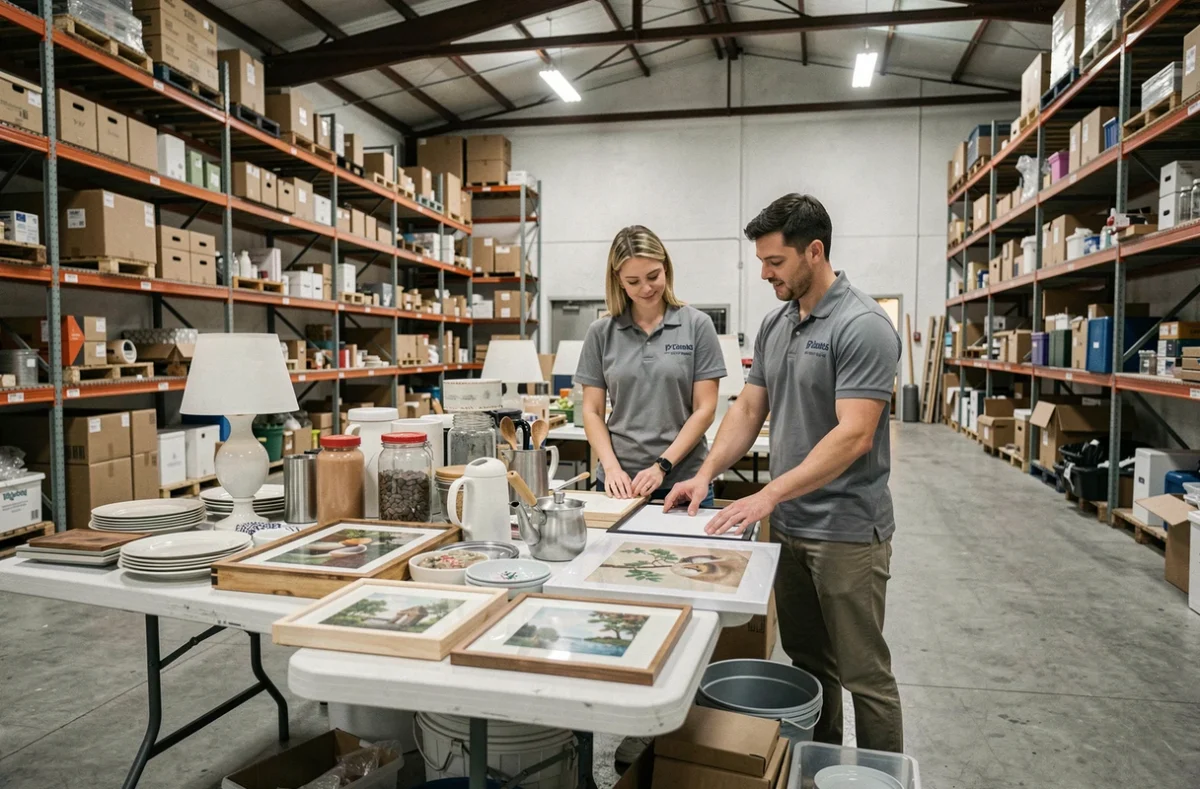
Dropping an item at a resource center does not guarantee its reuse. Before any resale, teams inspect, test, and sometimes repair each piece. La Petite Ourse, a resource center located in the Hautes-Alpes, describes processing, cleaning, and technical verification operations on the furniture, appliances, and clothing received.
A stained sofa or an electrical device without a power cable will be directed to material recycling, not to the solidarity shop. The condition of the item determines its final destination, and organizations may refuse a donation for hygiene, safety, or simply lack of commercial viability.
This sorting has a cost. It requires employee time, storage space, and sometimes technical skills (electrical testing, compliance checks). Before requesting a collection, it is possible to donate items on Concept Habitat to identify the appropriate pathways for each category of goods.
Items accepted by waste removal associations: concrete selection criteria
Associations do not take everything. Their storage capacity is limited, and each accepted item must be able to be resold, donated, or recycled within a reasonable timeframe. Contacting the organization before going avoids a refusal on-site.
The criteria vary from one association to another, but some constants emerge:
- Furniture and furnishings: accepted if they are in usable condition, without major structural damage (non-repairable broken leg, cracked top). Solid wood furniture is more likely to find a buyer than damaged particle board furniture.
- Clothing and textiles: clean, dry, without holes or permanent stains. Non-reusable textiles go to material recycling (insulation, industrial rags).
- Appliances: functional or repairable at low cost. A broken refrigerator whose repair costs more than a second-hand model will be refused.
- Dishes, knick-knacks, books: accepted if in good condition. Cracked, incomplete, or worthless items saturate stocks without generating resources.
Dropping a broken item at a collection point transfers a processing cost to an organization that is often financially fragile. The prior sorting by the donor directly conditions the efficiency of the circuit.
Economic model of reuse associations: why free waste removal has its limits
The promise of free waste removal is based on a simple calculation: if the resale value of the recovered items covers the cost of collection, sorting, and storage, the association does not need to charge. In practice, this balance is becoming increasingly difficult to achieve.
The National Observatory of Resource Centers and Recycling Centers, which relies on 2024 data from 231 organizations, reveals that the decrease in public funding weakens the associative model. The reuse funds from the AGEC law still represent a small part of these organizations’ resources. The increasing number of project calls imposes a heavy administrative burden, and the decrease in purchasing power reduces purchases in solidarity shops.
Moreover, competition from peer-to-peer sales platforms captures a growing share of high resale value items. Associations are recovering more low-margin items, which compresses their revenues while maintaining their logistical costs.
Direct consequence for the donor
Some associations now charge a fee for home pickup, especially when the volume is large or the items are difficult to resell. Others limit collections to certain days or specific categories of goods. Checking the conditions before any request avoids unpleasant surprises and allows for choosing the most suitable organization.

Professional integration: the other mission of waste removal associations
Resource centers are not just collection and resale points. A significant portion of them operates as structures for professional integration through economic activity. Employees in integration programs acquire skills in logistics, sales, repair, or stock management.
According to the National Observatory of Resource Centers and Recycling Centers, a significant portion of employees in integration moves towards sustainable employment or training. Donating items thus feeds a dual circuit: reuse of goods and support towards employment.
This social aspect fundamentally distinguishes associations from traditional waste removal companies. Entrusting your furniture or clothing to a recycling center directly finances a human support system, not just a logistical operation.
Waste disposal sites and the AGEC law: a relay for refused donations
An item refused by an association is not doomed to the dumpster. The AGEC law provides for the opening of waste disposal sites to actors in the social and solidarity economy, so they can recover still valuable items before their destruction.
This system creates a safety net for goods that escape the direct associative circuit. A piece of furniture dropped at a waste disposal site can be spotted by a partner resource center, restored, and resold. The complementarity between waste disposal sites and associations expands the chances of reuse.
Donating directly to an association remains the most effective way to increase the chances of an item’s reuse. The waste disposal site serves as a second resort when the volume or condition of the goods exceeds the capacity of the associative collection. In both cases, prior sorting by the owner, clear labeling of the operational condition, and a phone contact before moving remain the most useful gestures to ensure each item finds the right pathway.