Many Pilates practitioners never wear shoes for their session. Barefoot remains the norm in most mat classes. However, the question of footwear arises as soon as you change format, surface, or studio.
Rather than searching for the perfect pair, you must first understand what your foot does during a session, then adapt your choice to the specific context of your practice.
Pilates on mat or Reformer: the foot works differently
On a mat, the exercises engage the foot in direct contact with a soft and stable surface. The toes grip, the arch activates, and the intrinsic muscles of the foot contribute to balance. Removing your shoes allows you to maintain this connection to the ground.
On a Reformer, the situation changes. The carriage glides, the surfaces are smooth, and the foot must stay in place on a moving platform. Non-slip socks are often required for machine classes, according to Pilates Anytime’s recommendations. The grip of the sole then becomes a real safety parameter, not just a matter of comfort.
Have you ever slipped in regular socks on a waxed floor? That’s exactly what happens on a Reformer with ordinary socks. They can even be less safe than bare feet, as they reduce grip without providing compensation.
Before making any purchase, identify your primary practice format. A group class on a mat in a studio does not require the same equipment as a session on a machine in a specialized room.
Non-slip socks for Pilates: concrete selection criteria
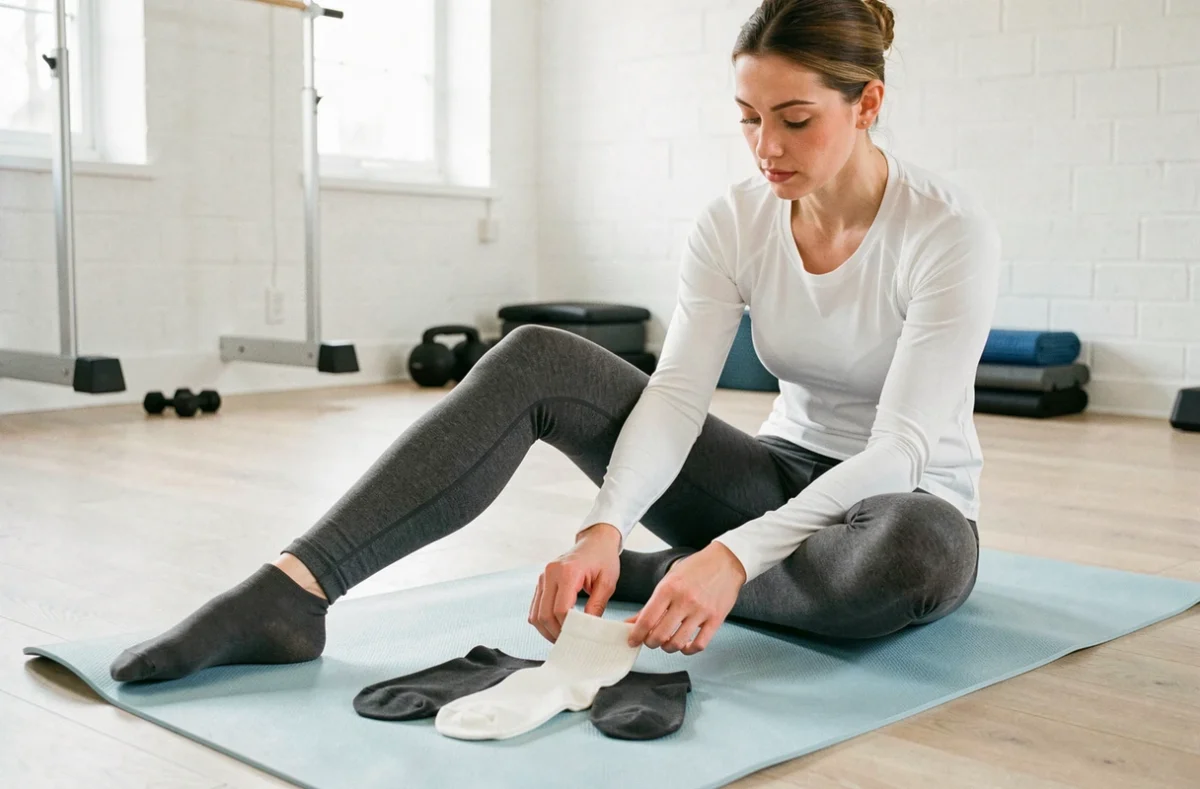
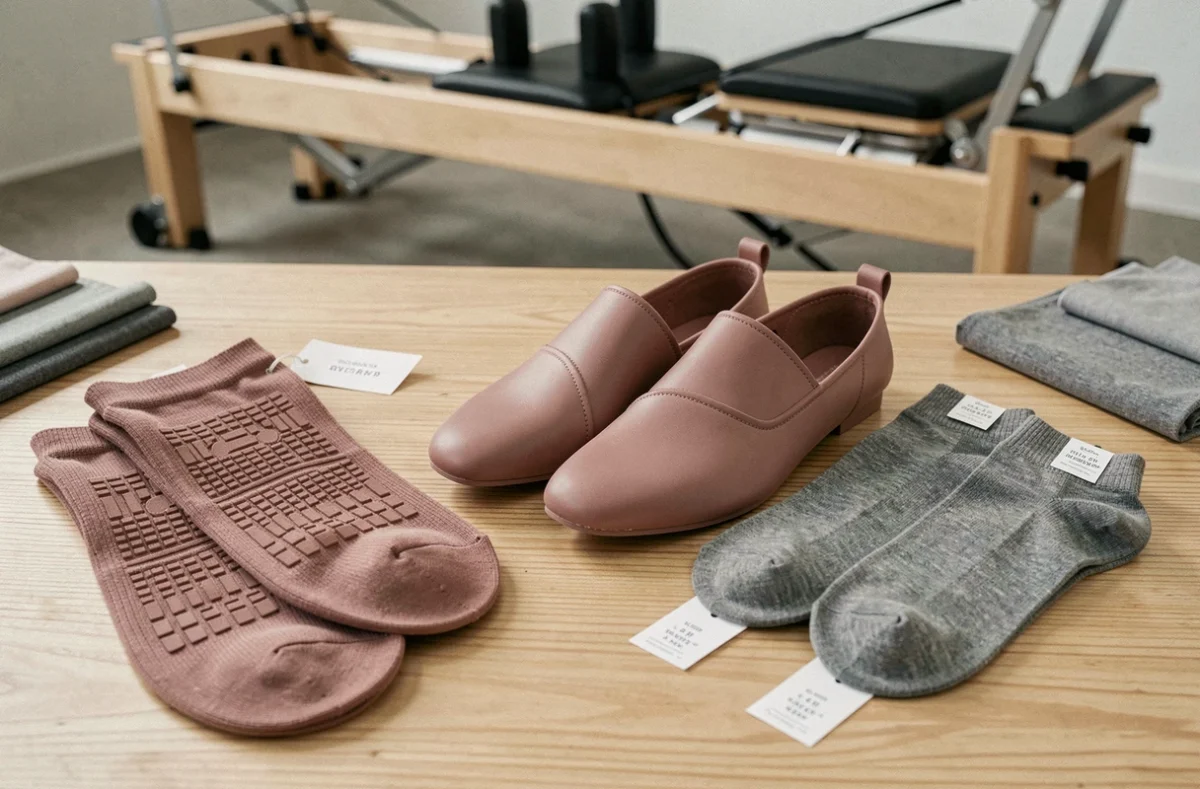
If you practice on a Reformer or in a studio that requires foot coverage, non-slip socks are the most suitable option for Pilates. To choose your Pilates shoes on 1 Sport 1 Coach, several technical criteria should be examined before relying on the aesthetics of the model.
Here are the points to check:
- The type of grip under the sole: silicone pads spread across the entire plantar surface provide superior grip compared to a simple partial textured coating. Ensure that the grip also covers the forefoot, the main support area in Pilates.
- The coverage of the foot (closed or open): some studios accept “toe-less” models that leave the toes free, while others require full coverage for hygiene reasons on shared equipment. This is not a detail; it’s a constraint for access.
- A snug fit without compression: a sock that is too loose moves during movements and negates the effect of the grip. It should hug the foot without compressing circulation.
- The breathable material: cotton blended with elastane offers a good compromise between softness, elasticity, and moisture-wicking.
Studio rules: the criterion that no one checks before buying
You can select the highest-rated sock on the market, but it will be useless if your studio does not accept it. Practices vary from one establishment to another, sometimes from one class to another in the same location.
Some studios require non-slip socks for all machine classes. Others allow bare feet and offer socks as an option. A few studios require full foot coverage, while others accept open models.
This difference is related to the hygiene protocols specific to each establishment, particularly for shared equipment (bars, straps, platforms). Check your studio’s registration guidelines before making any purchase. A quick email or call is sufficient.
Bare feet, socks, or shoes: what each format implies
The choice between these three options is not a matter of personal preference in all cases. Here’s what distinguishes them concretely:
- Bare feet: maximum activation of the foot muscles, direct contact with the mat. Suitable for mat classes in a clean space.
- Non-slip socks: a compromise between hygiene, grip, and proprioception. Recommended or mandatory on Reformer and similar machines.
- Minimalist shoes (like gym shoes): useful only if the studio allows them and if you have a specific support need (foot pathology, joint fragility). They reduce the sensory feedback from the ground, which goes against the principle of body awareness inherent in Pilates.
Grip and proprioception: why a thin sole changes everything
Pilates relies on precise, controlled movements where every support counts. A thick sole with pronounced cushioning (like that of a running shoe) cuts off the perception of the ground. The foot no longer “feels” the surface, and the brain loses part of the information necessary to adjust posture.
A thin sole preserves proprioception, which is the body’s ability to perceive its position in space. This is why experienced practitioners often prefer being barefoot or wearing very thin socks.
Grip, on the other hand, should not be confused with cushioning. In Pilates, we do not seek to absorb impacts (there is neither running nor jumping). We aim to avoid slipping during a slow and controlled movement. The grip matters more than the cushioning underfoot.
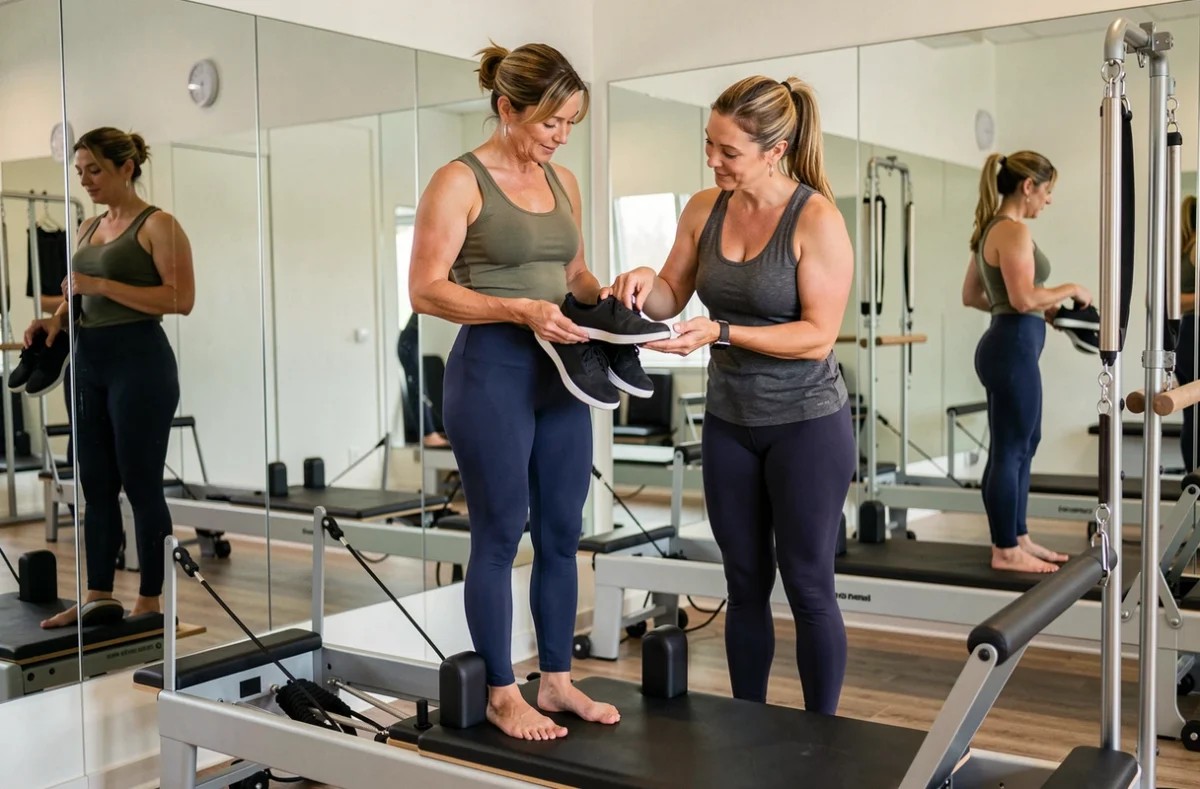
The right equipment for Pilates depends less on a brand or model than on the format of your class and the rules of your studio. A call to the studio, a look at the sole, a check of the grip: three simple actions that prevent unnecessary purchases or refusal at the entrance to the class.