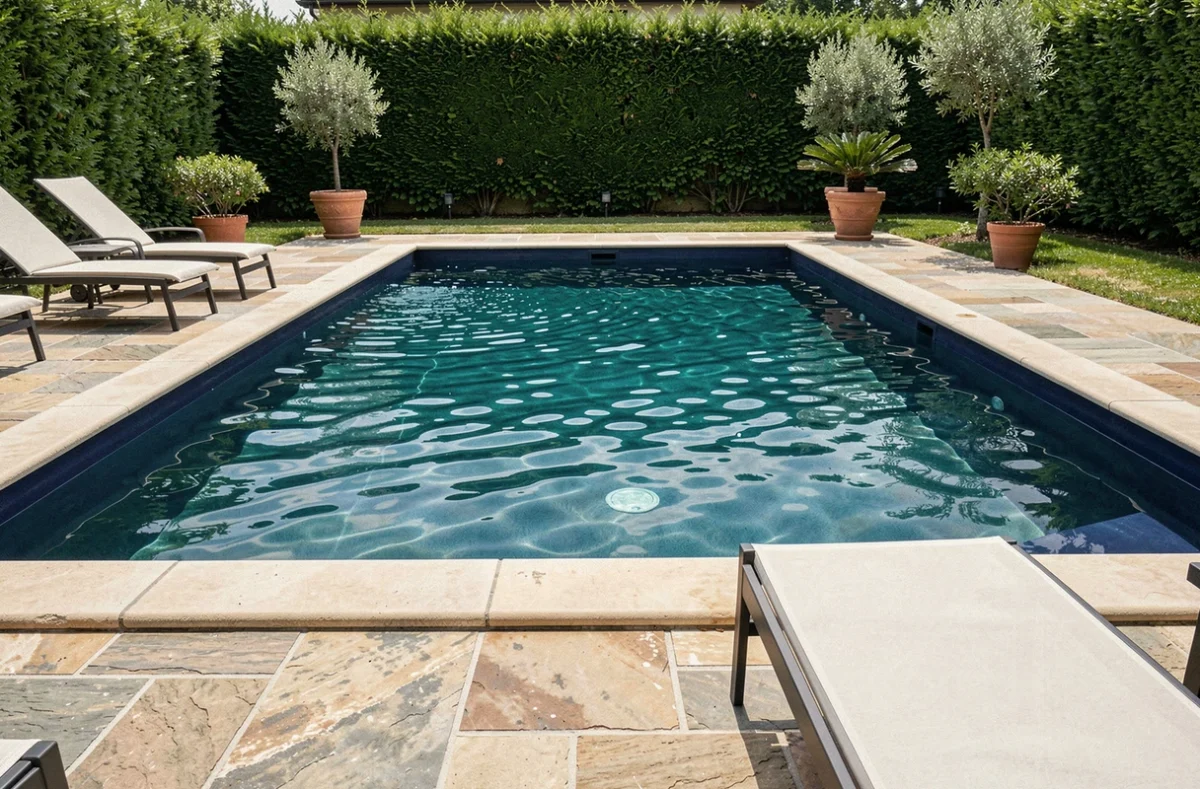
The color of the liner determines the perceived hue of the water, as well as how the pool integrates into its built and vegetative environment. Choosing a color involves balancing optical rendering, maintenance constraints, and the durability of the pigment in flexible PVC.
Interaction between liner pigment and light spectrum: what creates the color of the water
The final appearance of the water does not solely depend on the color of the PVC film. It results from the selective absorption of the solar spectrum by the pigment, combined with refraction and the depth of the pool. The same light gray liner will produce turquoise water in a shallow pool and steel-blue water in a two-meter deep pool.
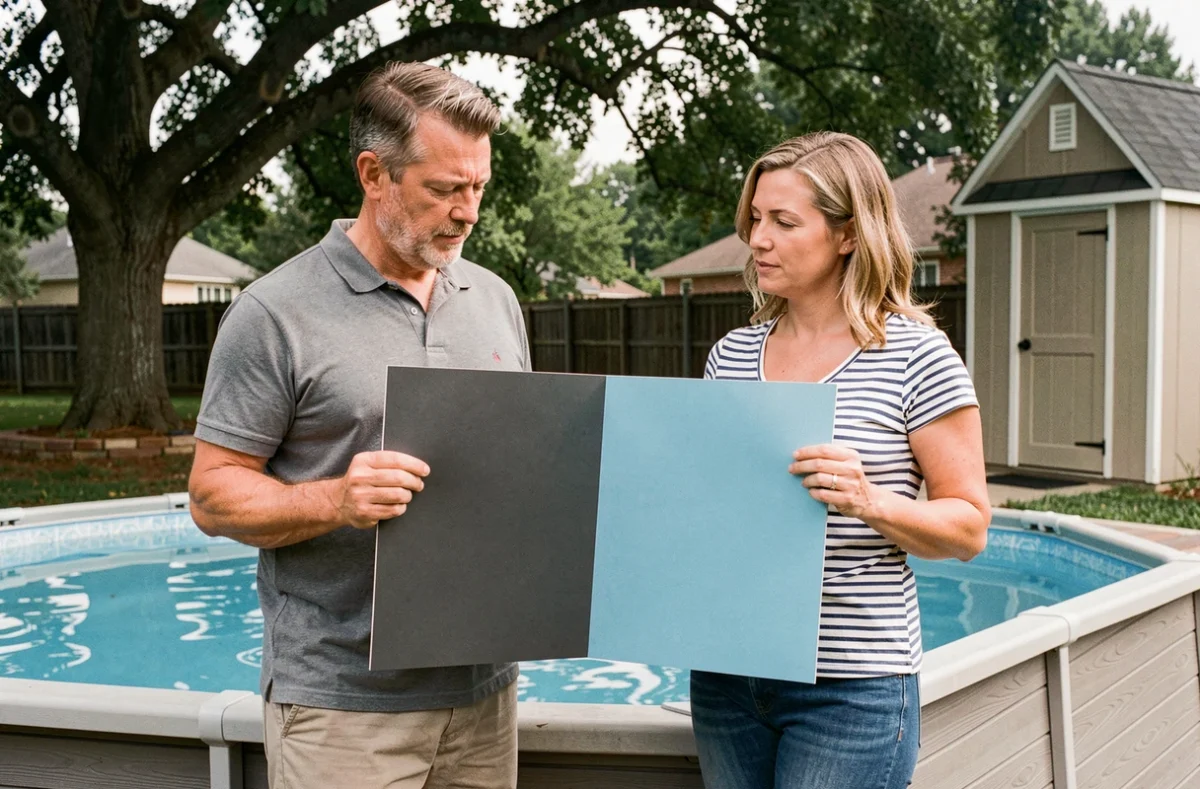
Liners with light pigments (white, sand, pearl gray) reflect more light. The water appears more transparent and the bottom remains visible, making it easier to detect deposits or emerging algae. Conversely, a dark liner (anthracite gray, black, dark green) absorbs a large part of the spectrum: the water takes on a deep hue, almost opaque in depth, and visual control of the cleanliness of the bottom becomes more difficult.
To visualize these differences in appearance before installing a covering, a pool liner color simulator on Idees-maison.com allows you to compare shades based on the pool’s configuration.
A often overlooked point: the orientation of the garden alters perception. A pool facing directly south under intense sunlight intensifies the saturation of the hue. The same sand liner will appear golden in southern exposure and greenish under dense tree cover on the northern side.
Liner color and maintenance constraints: stains, waterline, discoloration
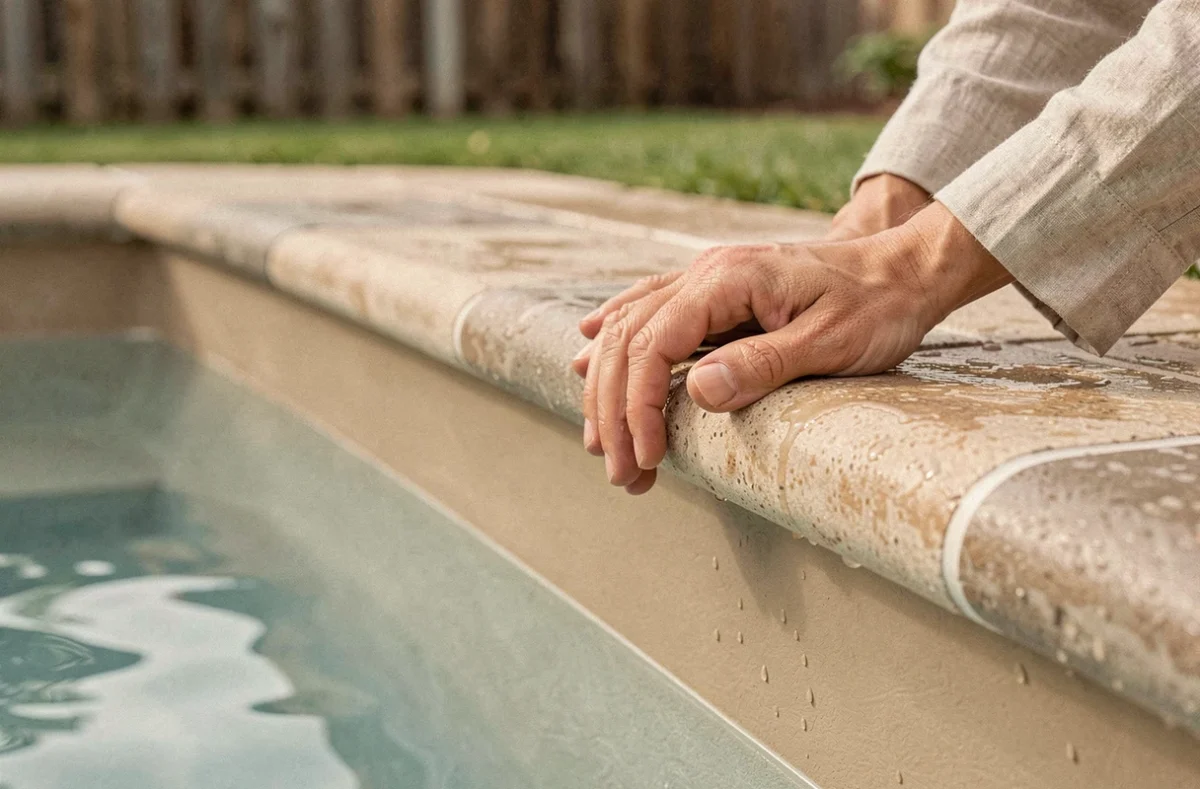
The waterline is the first visible indicator of aging. Body oils, sunscreens, and suspended particles concentrate there. On a white or sand liner, the deposit forms a yellowish edge if cleaning is not regular (soft sponge, non-abrasive product). On a dark liner, whitish limestone deposits as a veil and becomes very visible.
Choosing the color thus involves a concrete trade-off:
- Light shades (white, sand, light gray) are more exposed to organic stains and yellowing of the waterline but mask limestone deposits.
- Dark shades (slate gray, black, midnight blue) camouflage organic stains but reveal every trace of limestone or crystallized salt.
- Intermediate shades (medium blue, medium gray, Caribbean green) offer the best compromise by partially hiding both types of deposits.
An unbalanced pH accelerates the discoloration of flexible PVC, regardless of the chosen hue. Adding concentrated treatment products directly in contact with the covering (chlorine tablet placed on the liner, for example) causes irreversible whitening areas. This risk is more significant for dark liners, where pigment loss creates a marked contrast.
Sand, gray, or black liner: which color according to the shape of the pool and the environment
The geometric shape of the pool interacts with the color of the covering. A narrow, long swimming lane gains visual depth with a dark gray or anthracite liner, which enhances the perspective effect. A free-form pool with a submerged beach integrates more naturally into a landscaped garden with a sand or Caribbean green liner.
Sand and white liner: natural landscape integration
The sand liner produces emerald green to turquoise water depending on the depth. It pairs well with natural stone copings, wooden terraces, and Mediterranean or tropical environments. The white liner pushes the rendering towards a very light, bright blue but requires rigorous monitoring of the waterline.
Gray liner: the widest range of renderings
Gray remains the most versatile color for pools. From pearl gray to anthracite gray, the palette covers renderings ranging from lagoon blue to deep blue almost black. Light gray is suitable for family pools where visibility of the bottom is a safety criterion, especially with young children. Dark gray is oriented towards infinity pools or contemporary architectural basins.
Black liner: an aesthetic choice with specific constraints
The black liner transforms the pool into a water mirror. The visual effect is striking, especially with a dense vegetative environment or mineral architecture. The water temperature rises slightly faster with a black covering, as the pigment absorbs more infrared radiation.
The downside: every trace of limestone, every dried splash is immediately visible. The black liner requires more frequent waterline maintenance and precise chemical balance to avoid a whitish veil.
Recycling PVC liner and durability of color choice
The recycling sector for reinforced flexible PVC liners is beginning to take shape in France. A factory in Normandy, Plastique Valorisation, inaugurated in 2025, processes reinforced flexible PVC with fibers, including used liners. However, the actual tonnage processed is not publicly established to date.
The lifespan of the liner depends as much on maintenance as on the initial color choice. A dark liner whose pigment degrades visually faster than a light liner may lead to premature replacement for aesthetic reasons, even if the waterproofing remains functional. Incorporating this dimension into the color choice helps avoid prematurely renewing the covering.
The attachment profile (overlap, hung, rail) must match the structure of the pool. A liner designed for an above-ground pool cannot be installed on an in-ground pool, and vice versa. Checking the compatibility of the attachment system before confirming the color remains a technical prerequisite that the aesthetic question sometimes overlooks.