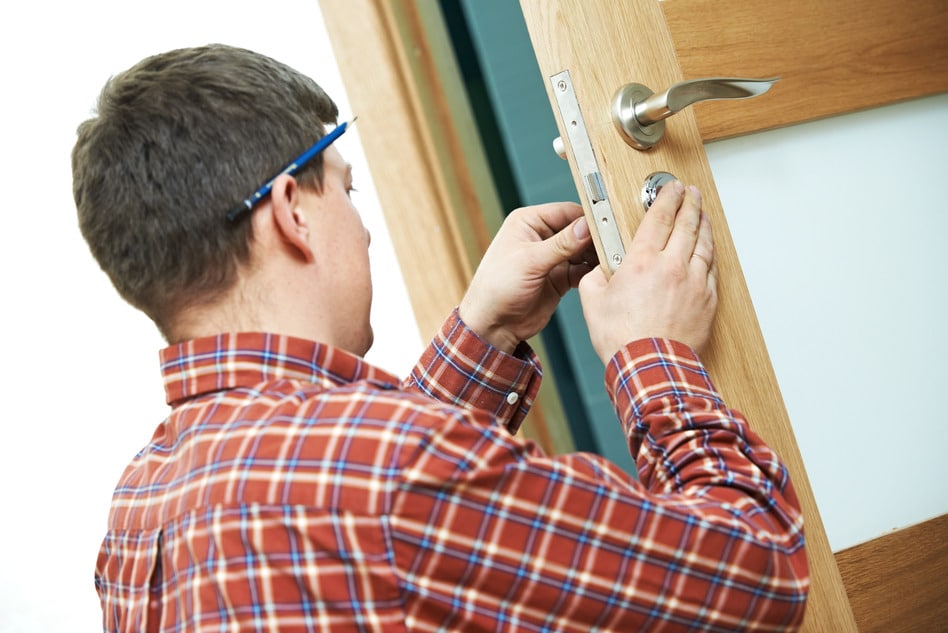
The locksmith, also known as a more technical locksmith, no longer only deals with locks and keys. He specializes in metalworking, shaping and working with all types of metal construction: from carpentry to framing and metallurgy.
Interested in this authentic profession? Want to learn more about training and salaries in the field? Discover how to become a locksmith through the testimonials of Jean-Michel, Christophe, and Ludovic.
What is the work of a locksmith?
Jean-Michel: It’s a craft profession. The project from A to Z is carried out in relation to the use of metals from design to installation, manufacturing, and shaping. We work on multiple constructions: doors, windows, gates or locks, but also artistic wrought ironwork.
Christophe: Cutting metal parts, bending, grinding, welding, and adjusting are all necessary phases for manufacturing metal elements intended to be integrated into a construction. We work on a multitude of diverse and varied works: locksmithing, armor plating, roller shutters, grilles, and gates. It’s a profession that requires good technical knowledge.
Ludovic: The metallurgical locksmith is, as the name suggests, a true expert in metallurgy. He specializes in shaping structures from metals, whether they are locks or larger constructions. Therefore, he does not only work in the context of repairs, even though that is part of his missions.
What do you like most about your job?
Jean-Michel: I have always loved working with metals, especially iron, to create handcrafted constructions. So it was only natural that I turned to this sector, which allows me to do what I love.
Christophe: I enjoy working with my hands, especially with metals. Starting from a raw material to arrive at a construction is always a pleasure.
Ludovic: What I like about this job is doing the work and then participating in the installation on the job sites. It changes the workshop, and the days go by faster.
What do you like least about your job?
Jean-Michel: We work in a particularly noisy and dusty environment that is not always easy to endure.
Christophe: Working on scaffolding at heights is not always very reassuring, even though everything is safe. I must admit that I am a bit clumsy.
Ludovic: It’s quite a tiring job. We work standing for hours, and it’s necessary to always be very focused on our task to do things correctly.
What qualifications are required to practice this profession?
Jean-Michel: It is imperative to know how to follow safety instructions for everyone’s well-being. We work with dangerous equipment.
Christophe: One must be resourceful and very meticulous. Constructions are made to the nearest millimeter, as with locks, for example.
Ludovic: Good physical endurance is necessary to practice this profession.
What training is required to become a locksmith?
To become a locksmith, several training courses are offered to candidates:
- CAP locksmith metalworker.
- Locksmith BP, metallurgy.
- Additional mention (MC) welding.
- Professional platform for building works: metalworking.
- Techno Plate STI2D.
- BTS boiler making.
- Metal construction BTS.
However, to practice the profession of city locksmith (Convenience and Installer), it is imperative to hold a certification issued by a training organization recognized in the French National Directory of Professional Certifications (RNCP). This certification is available to anyone with a level IV (Bac).
Is there competition to practice this profession?
No.
Are there specialized schools in this field?
Yes, FMSD Training is the only training center authorized to issue accreditation to practice the profession of repair locksmith installer.
What salary does a locksmith earn?
A beginner locksmith is paid close to the minimum wage.
This salary varies depending on experience and the structure in which the locksmith operates (self-employed or employed).
What advice would you give to those wishing to practice this profession?
Jean-Michel: Opportunities are very significant in this profession, so if you are interested in metallurgy: go for it!
Christophe: Locksmithing is a vast field, so specialize in what you love most after trying out the different branches of the profession.
Ludovic: There are many opportunities for advancement in this sector. If you are interested in working with metal, you will certainly find a job that suits you and in which you will thrive.
Tag : how to become a locksmith